
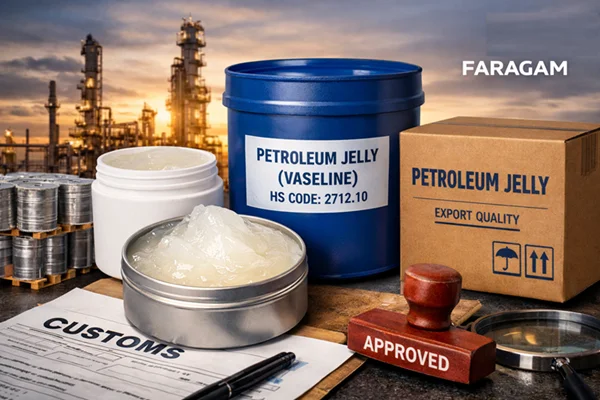
Petroleum Jelly (Vaseline) HS Code, Safety, Handling & Global Trade Guide
Petroleum jelly—commonly known as Vaseline—is one of those quiet industrial heroes. Colorless, semi-solid, chemically boring in the best possible way, and extremely useful. From cosmetics and pharmaceuticals to rubber processing and cable protection, this material moves enormous volumes through global trade every year.
For importers, exporters, and compliance teams, understanding the HS code of petroleum jelly, its classification versus other paraffin products, and its safety and handling requirements is essential. This guide breaks it all down clearly and commercially, with export relevance for Faragam Company.
What Is Petroleum Jelly (Vaseline)?
Petroleum jelly is a semi-solid mixture of hydrocarbons obtained from petroleum refining. Chemically, it belongs to the paraffin family but differs in texture, melting range, and application.
Key characteristics:
-
Semi-solid at room temperature
-
Water-insoluble
-
Odorless or near-odorless
-
Chemically stable
-
Long shelf life
It is produced in technical grade, cosmetic grade, and pharmaceutical grade, depending on refining depth and purity.
Petroleum Jelly HS Code (Customs Classification)
International HS Code for Petroleum Jelly
The standard HS code for petroleum jelly under the Harmonized System is:
HS Code: 2712.10
Description: Petroleum jelly; paraffin wax, microcrystalline wax, slack wax
In many countries, petroleum jelly is further specified at 8-digit or 10-digit levels depending on purity and use.
Why Correct HS Code Matters
-
Accurate customs clearance
-
Correct duty and VAT calculation
-
Avoidance of shipment delays
-
Compliance with import regulations
-
Smooth LC and banking documentation
Faragam Company ensures correct HS declaration according to destination country requirements.
HS Code Comparison – Petroleum Jelly vs Other Paraffin Products
| Product Name | HS Code | Physical Form | Typical Applications |
|---|---|---|---|
| Petroleum Jelly (Vaseline) | 2712.10 | Semi-solid | Cosmetics, pharma, rubber, cable |
| Fully Refined Paraffin Wax | 2712.20 | Solid slabs | Candles, packaging, coatings |
| Semi Refined Paraffin Wax | 2712.90 | Solid slabs | Match sticks, boards, rubber |
| Microcrystalline Wax | 2712.20 | Solid, plastic | Cosmetics, adhesives |
| Slack Wax | 2712.90 | Soft solid | Wax upgrading, oil blending |
This comparison is useful for customs officers, buyers, and logistics planners, especially when mixed paraffin cargoes are shipped.
Safety, Handling & Storage of Petroleum Jelly
General Safety Profile
Petroleum jelly is considered non-hazardous under most international transport regulations (ADR, IMDG, IATA), but proper industrial handling is still essential.
-
Non-toxic under normal use
-
Non-corrosive
-
Not water-reactive
-
Combustible at high temperatures
Handling Guidelines
-
Use clean tools to avoid contamination
-
Avoid overheating beyond recommended melting range
-
Prevent contact with open flames
-
Industrial gloves recommended for bulk handling
Storage Conditions
-
Store in cool, dry, shaded areas
-
Keep containers tightly sealed
-
Avoid prolonged exposure to sunlight
-
Shelf life: typically 5 years or more when stored correctly
Transport Notes
-
Supplied in drums, cartons, or bulk packs
-
No special labeling required for non-hazard status
-
MSDS available upon request from Faragam Company
Global Trade & Applications of Petroleum Jelly
Petroleum jelly is widely imported by:
-
Cosmetic manufacturers
-
Pharmaceutical producers
-
Rubber and tire factories
-
Cable and wire manufacturers
-
Textile and leather processors
Major importing regions include Africa, Middle East, East Europe, South Asia, and parts of Latin America, where demand remains stable and growing.
Faragam Company supplies export-grade petroleum jelly with consistent quality and international documentation support.
Why Source Petroleum Jelly from Faragam Company?
-
Reliable HS code declaration
-
Export-standard packaging
-
Consistent quality control
-
Experience in international shipping
-
MSDS & technical documentation support
-
Professional handling of trade compliance
Faragam positions itself not just as a supplier, but as a trade-ready partner for petroleum-based products.
Frequently Asked Questions (FAQ)
What is the HS code for petroleum jelly?
The standard international HS code is 2712.10, covering petroleum jelly and related paraffin products.
Is petroleum jelly classified as hazardous?
No. Petroleum jelly is generally classified as non-hazardous, though it is combustible at high temperatures.
What is the difference between petroleum jelly and paraffin wax?
Petroleum jelly is semi-solid with a lower melting range, while paraffin wax is solid and used mainly for candles and coatings.
Can petroleum jelly be used in pharmaceutical products?
Yes, pharmaceutical-grade petroleum jelly is widely used in ointments, creams, and medical formulations.
Does Faragam Company provide MSDS?
Yes. MSDS and technical data sheets are available upon request for all petroleum jelly shipments.


