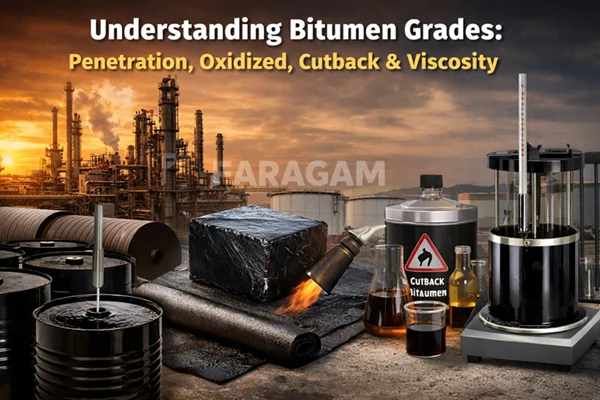
Understanding Bitumen Grades: A Complete Exporter’s Guide by Faragam
What Is Bitumen and Why Grades Matter
Bitumen is a black, sticky, thermoplastic material derived from crude oil and widely used as a binder in road construction, waterproofing, roofing, and industrial coatings. Its performance depends heavily on its grade — a classification of physical characteristics such as hardness, viscosity, and thermal resistance.
Penetration Bitumen (Standard Grades)
Penetration bitumen is the most common category used in traditional asphalt and paving applications. It is graded by the depth (in 0.1 mm) a standard needle penetrates at 25°C — lower numbers indicate harder, more rigid material; higher numbers mean softer bitumen.
Typical Penetration Grades Supplied by Faragam
| Grade | Penetration (0.1 mm) | Typical Use |
|---|---|---|
| 30/40 | 30–40 | High-temperature roads, heavy traffic pavements |
| 40/50 | 40–50 | Hot climates, highways |
| 60/70 | 60–70 | All-purpose roads, airports |
| 80/100 | 80–100 | Cold climates, flexible pavements |
| 100/120 | 100–120 | Lower performance roads |
| 200/300 | 200–300 | Very soft binder, cold mixes |
Applications: Road surfacing, binder and surface courses in hot mix asphalt, residential roads, and various paving works.
Oxidized (Blown) Bitumen
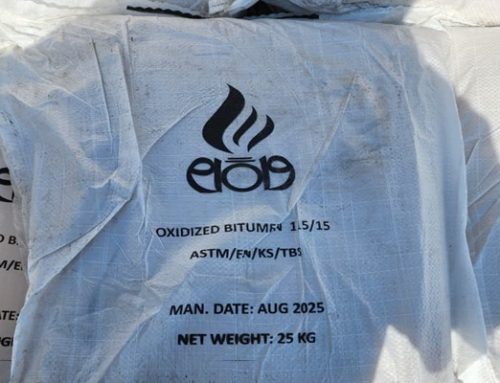
Oxidized bitumen is produced by blowing hot air through penetration bitumen, increasing the softening point and reducing penetration. This yields a harder, more heat-resistant product ideal for industrial and waterproofing uses.
Key Oxidized Grades (Typical Properties)
| Grade | Softening Point (°C) | Penetration (dmm) | Typical Uses |
|---|---|---|---|
| 85/25 | ~85 | ~25 | Roofing, waterproofing, coating |
| 95/25 | ~95 | ~25 | High-temp industrial coatings |
| 115/15 | ~115 | ~15 | Heavy duty insulation, pipe coatings |
Applications: Roofing felts, insulation membranes, waterproofing layers, industrial pipe and joint coatings.
Cutback Bitumen
Cutback bitumen is bitumen diluted with solvents to reduce viscosity and ease application at lower temperatures. It is categorized by curing speed:
-
RC (Rapid Curing): Fast evaporation — used where quick set is needed.
-
MC (Medium Curing): Balanced evaporation — general road maintenance.
-
SC (Slow Curing): Slow evaporation — deep penetration in base courses.
Example Grades: RC70, RC250, MC30, SC800, SC3000
Applications: Primer coats, cold climate road works, surface dressing, maintenance projects.
Viscosity & Performance Grades
Viscosity Grade (VG): Classified by kinematic viscosity at 60°C — VG30 and VG40 are common for high-traffic, hot climates.
Performance Grade (PG): Climate-based grading used especially for highways and high-speed pavements — e.g., PG64-10, PG76-22.
How Faragam’s Bitumen Stacks Up: Comparative Table
| Grade Type | Primary Test | Strength | Typical Climates | Main Uses |
|---|---|---|---|---|
| Penetration | Needle Penetration | Flexible binder | Varies by grade | Roads & asphalt |
| Oxidized | Softening Point & Penetration | High heat resistance | Warm/industrial | Waterproofing & coatings |
| Cutback | Solvent Viscosity | Easy application | Cold | Primer & maintenance coats |
| Viscosity (VG) | Viscosity | Balanced temp performance | Hot & cold | High performance roadworks |
| Performance (PG) | High/Low temp | Very specific climate tuned | Extreme | Airports, highways |
Global Bitumen Demand & Trade
Exporting Countries: Iran (8–10 M MT/yr), UAE, India, Russia, Singapore — supplying key grades like 60/70, VG30, VG40 worldwide.
Importing Markets:
-
India, China, South Asia: Driven by massive road and infrastructure expansion.
-
Africa: Growing demand for road networks and industrial bitumen.
-
Europe: Specialized oxidized bitumen for industrial and roofing uses.
-
Middle East & Southeast Asia: High-temperature pavements and construction projects.
Handling, Packing & Logistics
Faragam supplies bitumen in a range of packing formats to match project needs:
-
Bulk shipment (tankers) for large volume contracts.
-
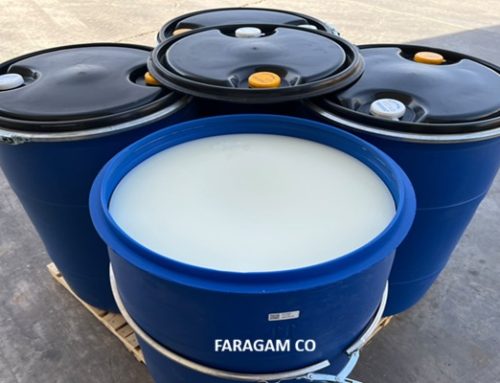
Steel Drums (150–220 kg) ideal for smaller deliveries and distant land transport.
-
Jumbo Bags / Flexi-bags (500–1000 kg) for ease of handling on job sites.
Proper handling should follow safety guidelines for temperature control, ventilation, and protective equipment due to high temperature and VOC hazards in cutback products.
Frequently Asked Questions (FAQs)
What determines a bitumen grade?
Grades are determined by physical tests like penetration (hardness) and softening point (temperature resistance), tailored to specific project demands.
Why choose oxidized over penetration bitumen?
Oxidized bitumen offers better heat resistance and rigidity for industrial and waterproofing uses, while penetration bitumen is preferred in road-binding layers.
Is cutback bitumen environmentally safe?
Cutback contains solvents that can emit VOCs; modern markets often prefer emulsion or heated binders for reduced environmental impact.
How does climate affect grade selection?
Cold regions use softer penetration grades (e.g., 80/100), while hot climates and heavy load roads need stiffer grades like 40/50 or VG40.
Why Choose Faragam as Your Bitumen Supplier
Faragam is a premier manufacturer and exporter with capabilities to produce across all major bitumen categories — penetration, oxidized, cutback, viscosity, and performance grades — tailored to international standards. Our supply chain reaches key markets including India, China, Africa, the Middle East, and Europe with flexible packing, competitive pricing, and rigorous quality control to support infrastructure and industrial projects globally.